A quick overview of the Sky Cowboys world from the perspective of the people who live there:
Chasms cut across the landscape, breaking the surface into “land islands” of all sizes. They range from a scant few hundred feet across to hundreds of miles wide. No one knows how deep the chasms are. The floors (if they have floors) are shrouded by mist, and everyone who’s ever ventured below the mist has never returned.
Only creatures with the power of flight can cross the chasms. Many animals evolved some sort of flight mechanism or adapted to live in the sky. Those that did not remain isolated and further adapted for their highly specific ecosystem.
The people of the world often live in humble dwellings made of timber or brick. The general technology level is that of the 1700′s of our world: steam, coal, iron, some steel. Pegasus feathers have also become a useful commodity due to their lightweight but sturdy properties.
Mankind tamed the pegasus so they could cross the chasms. Those who fly pegasi are called “pilots”. Pilots herd other creatures and carry goods/messages across the chasms. They are the center of trading between the “islands”. It’s considered a dangerous job. Most pilots are courageous, rough, wild, daring, and highly talented. They consist of both men and women.
Over the years, pilots and craftsmen have developed specific gear and specialized saddles with which to ride pegasi. Most saddles are narrow in front to rest between the pegasus’ wings with a high cantle in the back. The pilot’s knees rest on the base of the wings (they look like how a jockey sits on a racehorse). Heel slings strap around the heel of the boot to hold the foot in place. Most of the pilots weight in flight rests on the strap, rather than on the wings. Pilots don’t often use bridles. They rely on voice and leg commands to steer their pegasus.
As for the pegasi themselves, there are 3 main species:
The Broadwing Peagsus is the workhorse (har har) of the world. Most pilots ride these. Found all over the world, they’re sturdy, reliable, and robust. They’re based on quarter horses and mustangs or similar breeds. Their wings are comparable to eagle, owl, kite, and hawk wings. Broadwings are technically omnivores, though the vast majority of their diet is vegetarian. They are not considered predatory, and travel in flocks up to 50 strong. Like horses in our world, there is a clear herd hierarchy with a boss mare and protecting stallion.
The Longwing Pegasus is a coastal breed. They live largely solitary lives and roost/live on the cliff sides of the oceans. Based on lighter horse breeds like Akhal Tekes, Warmbloods, and Thoroughbreds, they are a bit more fragile but have more stamina than broadwings. They tend to be energetic, flighty, highly intelligent. Their wings are similar to gulls, albatross, and terns. They eat mostly fish by skimming the tops of the waves, or diving down into the water.
The Shortwing Pegasus is the draft horse of the world. They are generally flightless unless aided by intense winds. They’re steady, slow, and flashy. Based on songbirds, pheasants, ducks, and peacocks, they’re quite colorful. Often used for heavy farm work, or hauling over land. They eat seeds, nuts, and grasses. Untamed they also travel in flocks, but tend to keep nearby forests for the safety of tree cover from flying predators.
Things I want to explore are pegasus competitions, the floors of the chasms, the coastal regions, towns in general, and clothing (flight and day clothes)
Another morph doodle! I’d be lying if I said I wasn’t itching to get this one drawn, because damn if I don’t love big draft horse bodies. They just reek of powerful grace, don’t they?
Anywho, this lovely lady’s a good example of what you’ll see in the Russian and Canadian subtype of falsicorn. I’m sure there are some little defining quirks between the two if you squint, but they all have a lot of shared traits, the most obvious and striking if which is really just how freakin’ huge they are. Harsh, nearly year-round winter conditions have developed them into mammoth creatures, with incredibly thick, sturdy bones, extremely dense coats, and a solid layer of insulating fat to keep their organs warm. They could probably make a Clydesdale look scrawny by comparison, and are, at least on average, the undisputed largest of all present day falsicorns.
As you might expect, the majority of fairly type specific genes have to do with hair growth. This particular individual doesn’t have it, but many possess a longer fur type that makes them look more like a giant Great Pyrenees than a horse. Lion-esque mane wrappings and “lynx cheeks” are also common (all of which are present here), which can manifest in varying degrees.
Don’t let the bulk fool you, either. Sure, they’ll never win any racing competitions with, say, a desert morph, but that doesn’t mean they aren’t entirely capable of chasing down humans (easily) on foot and then just bulldozing the poor sod flat. Their physical strength and prowess are damn near legendary, and needless to say, picking a fight with one would probably not end well.
As with all types, they can theoretically come in just about any standard horse color under the sun and then some, though washed out greys and whites (both warm and cool) are the most common. Their horns don’t generally grow very ‘long’ either, and wind up about as stout as the rest of them. Faces are also fairly draft-esque with a roman slope in their profile. Fangs tend to be thicker and longer than other morphs, with canines often visible (and prominent) even when the mouth is small. Potential for saber tooth genes, maybe? Awww yeeeeah.
Oh, and their tails and tail claws are also just stupidly thick and powerful, too. Trust me, you don’t want that thing swung at you; it could probably shatter a human femur easily in one blow.
Han’s world-building is AMAZING, you guys. This blog has stolen hours from my last week. Falsicorns are a fascinating low-key horror subject. Reminds me a lot of Neil Gaiman’s writing – beautiful, creepy, and incredibly immersive.
Check them outǃ
(Noteː I object to the suggestion that Canada has ‘nearly year-round’ winters. Snow is only FIVE months a yearǃ Below freezing temperatures are almost never more than 7 monthsǃ Even in the Northǃ ~winky face~ )
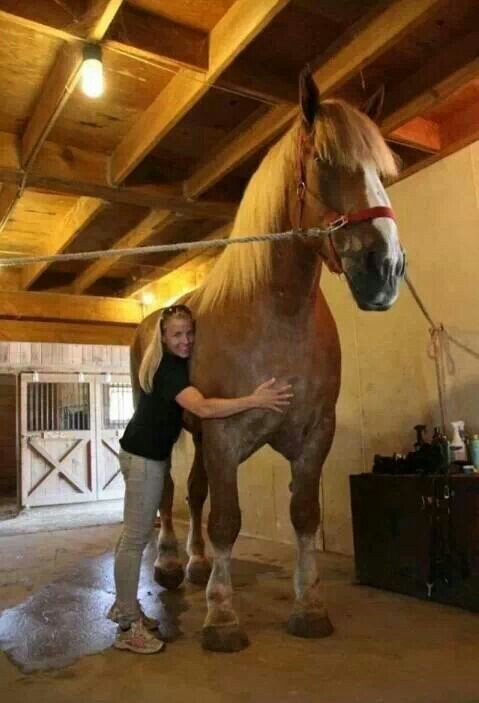
I never made a post about draft horses. :T They are the gentle giants of the horse world, sometimes growing as large as 20 hands and over 2000 lbs. The tallest horse in the world is an American-type Belgian horse named Big Jake (I think???).
A very big (but good) boy!
Despite their size, draft horses are known for their quiet, even temperaments, which make them good work horses. They were originally bred to pull wagons and plows, and they still do that. The most famous draft horses are probably the Budweiser Clydesdales, i.e. the horses in those Superbowl commercials that make us cry every goddamn year.
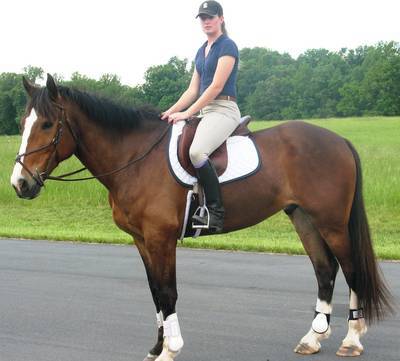
Draft horses can be ridden, and they are often crossed with lighter breeds, such as Thoroughbreds and Quarter Horses, to create tall, sturdy-boned, quiet sport horses.
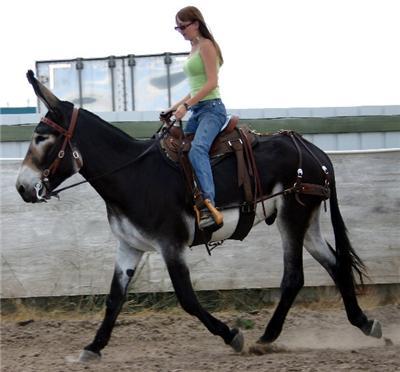
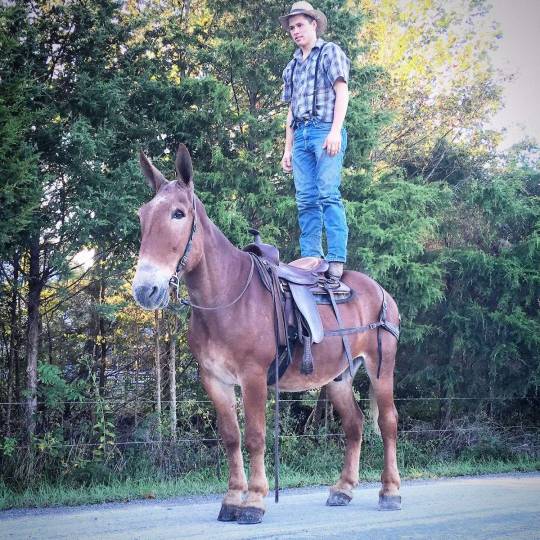
Such horses were a common sight during foxhunts, as “hotter” breeds, like Arabians and Thoroughbreds, tend to lose their minds a bit in the chaos of the hunt. Draft horses can also be crossed with Mammoth Jack donkeys to create draft mules, which are also used to pull plows for the Amish.
Mammoth Jack donkey:
Draft Mule:
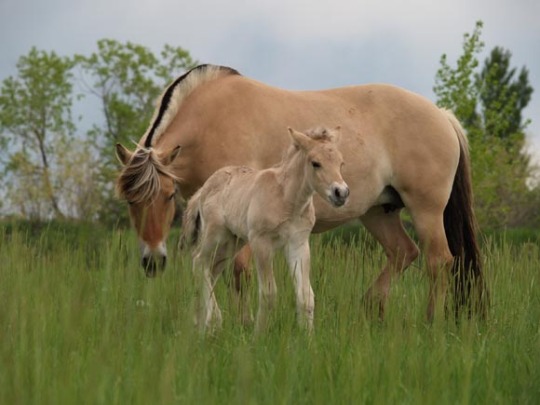
There are a lot of draft breeds, some more common than others. Many of the common ones are easy to tell apart from the others, but they’re all large-boned and tall, except for the draft ponies, such as Halflingers and Norwegian Fjord horses.
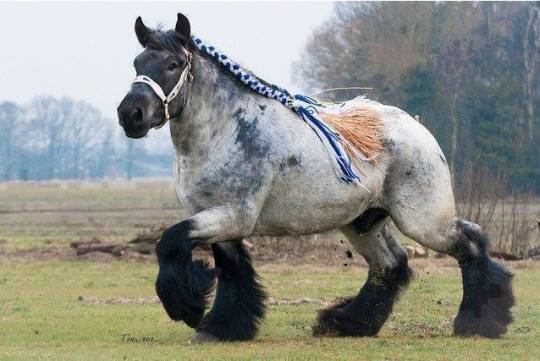
The Belgian
There are two Belgian horses, one that’s popular in Europe and another that’s very common in the US.
This is the European-type “Brabant” Belgian, which tends to be very thick boned and roan in color.
This is the American-type Belgian, which is lighter-boned and always sorrel/palomino in color:
Here is a Brabant Belgian mare pulling some shit:
A lot of draft horses really do enjoy pulling stuff, as much as a horse CAN enjoy doing anything that’s not eating grass and farting. Horse pulls are a common sight in Middle America, often done using Belgian horses. Here’s one of a team pulling 9200 lbs. They pull for a very short period of time, often only a few seconds.
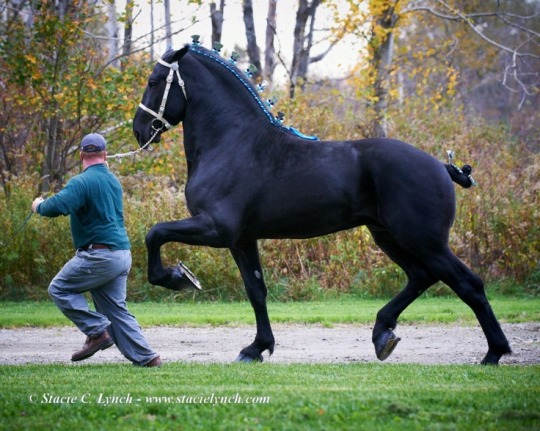
Next up is the Percheron, which has a similar body type to the Belgians but are always black or dapple. They can be slightly more spirited than Belgian horses, with some demonstrating high stepping action.
They are not to be confused with Friesians, who have much more “feathered” legs and feet (long hair around the lower legs) and are lighter-boned. Friesians also don’t come in dapple colors, like the horse at the top of this post.
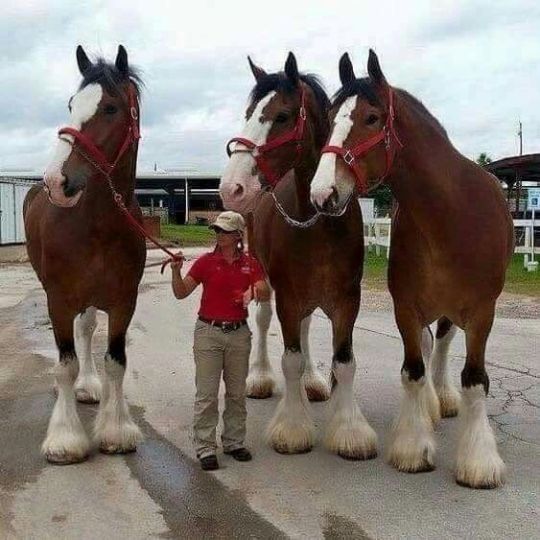
Clydesdales
Clydesdales are recognizable because they are a) always bay colored and b) almost always have four white socks and a blaze on their faces. They also have much more feathering on their legs than Percherons or Belgians. Clydesdales are more common in parades and the like because they tend to be slightly lighter than Percheron and Belgians, and because of this, they’re more agile and “showy”. You probably would not want to plow with a Clydesdale. You could, but their feathering means their feet get dirty much easier than a Belgians might.
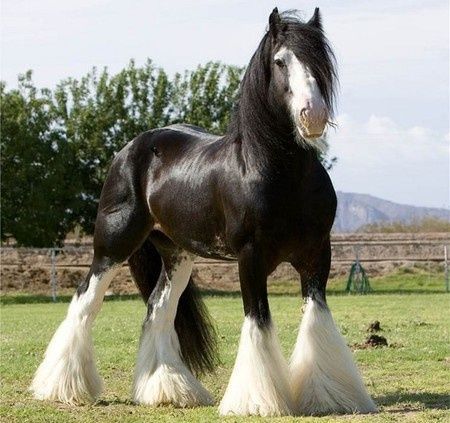
Shire Horse
Shires come in a variety of colors, usually black or bay, and they are probably the most “feathered” horses of the popular breeds. They’ve got lots of fur on their feet.
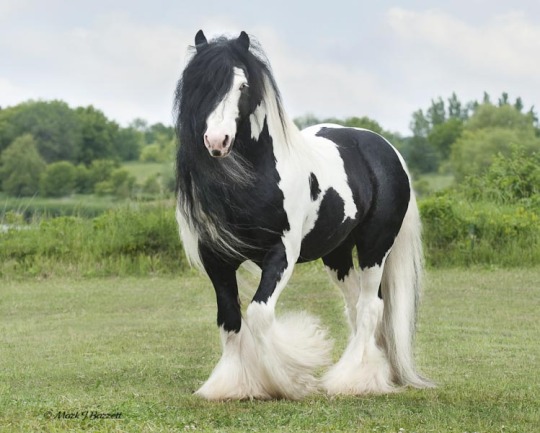
Gypsy Vanner Horses
Gypsy Vanner horses got their start pulling Roma wagons, but now they’re mostly used in fantasy photoshoots, and you can see why. They are beautiful horses, definitely not the type you’d want toiling in the muck. They are almost always paint colored, which distinguishes them from Shire horses.
These are the main, most popular and commonly seen full-sized draft breeds, at least in the US. However, there are also draft ponies, the most popular of which is the Halflinger, which resembles a shrunken Belgian horse. They are ALWAYS sorrel/palomino colored, but their frame can vary. Some Halflingers are lighter-boned and more suitable for riding. Others are thicker-boned and better for pulling.
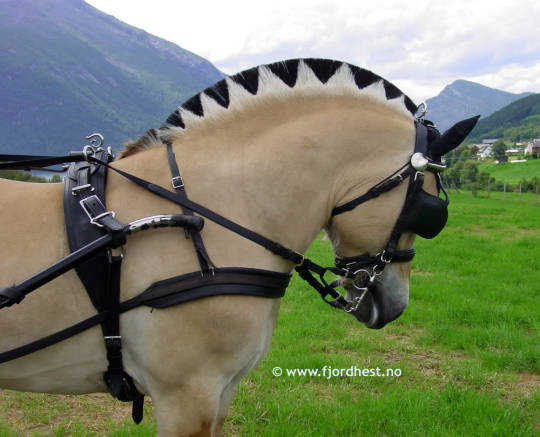
The other unmistakable draft pony is the Norwegian Fjord, easily recognized by the black stripe in the center of its mane, like a reverse ice cream sandwich.
This can lead to some creative hair cuts
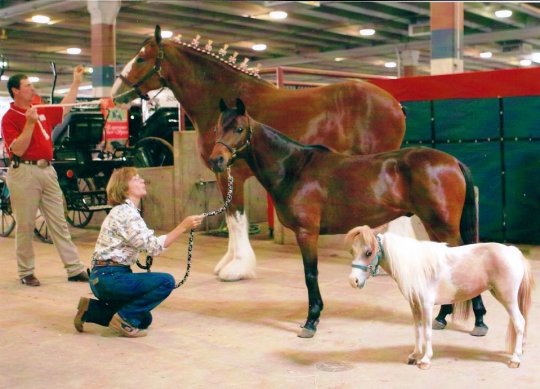
So there you go. That’s a somewhat comprehensive review of draft horse breeds. Here is a size comparison for funsies, with the average riding horse in the middle.
@betterbemeta are you able to translate this? Is it true horses can see netherbeings?? Will we ever know the extent of their powers???
I think I have reblogged this before but I’ll answer it again bc its a fascinating answer I feel and i was more funny than informational last time.
The truth is that horses see what they think are nether beings, I guess. They have a perfect storm of sensory perception that, useful for prey beings, marks false positives on mortal danger all the time. Which is advantageous to a flight-based prey species: running from danger when you’re super fast is much ‘cheaper’ than fighting, so you waste almost nothing from running from a threat that’s not there. Versus, you blow everything if you don’t see a threat that is there.
Horses also have their eyes positioned on the sides of their heads, which gives them an incredible range of peripheral vision almost around their entire body with only a few blind spots you can sneak up on them in. But this comes at the cost of binocular vision; they can only judge distance for things straight ahead of them. Super useful for preventing predators sneaking up from the sides or behind, but useless for recognizing familiar shapes with the precision we can.
Basically we now have a walking couch with anxiety its going to get attacked at any second, that can see almost everything, but mostly only out of the corner of its eye. It has a few blind spots and anything that suddenly appears out of them is terrifying to it. Combine that with that it actually has far superior low-light vision than us, and that its ears can swivel in any directions like radar dishes, and you’ve basically given a nervous wreck a highly accurate but imprecise danger-dar.
To be concise: all horses, even the most chill horses, on some level believe they are living in a survival horror.
This means that you could approach it in a flapping poncho and if it can’t recognize your shape as human, they mistake you for SATAN… or you could pass this one broken down tractor you’ve passed 100 times on a trail ride, but today is the day it will ATTACK… or your horse could feel a horsefly bite from its blind spot and MAMA, I’VE BEEN HIT!!!… or you could both approach a fallen log in the woods but in the low light your horse is going to see the tree rings as THE EYE OF MORDOR.
However, they actually have kind of a cool compensation for this– they are social animals, and instinctively look towards leadership. In the wild or out at pasture, this is their most willful, pushy, decisive leader horse who decides where to go and where it’s safe. But humans often take this role both as riders and on the ground. They are always watching and feeling for human reactions to things. This is why moving in a calm, decisive way and always giving clear commands is key to working with this kind of animal. Confusing commands, screaming, panic, visible distress, and chaos will signal to a horse that you, brave leader are freaked out… so it should freak out too!
On one hand, you’ll get horses that will decide that they are the leader and you are not, so getting them to listen to you can be tough– requiring patience and skill more than force. On the other hand, a good enough rider and a well-trained horse (or a horse with specialized training) can venture into dangerous situations, loud and scary environments, etc. calmly and confidently.
The joke in OP though is that many horses that are bred to be very fast, like thoroughbreds, are also bred and encouraged to be high-energy and highstrung. Making them more anxious and prone to seeing those ‘demons.’ All horses in a sense are going to be your anxious friend, but racehorses and polo ponies and other sport horses can sometimes be your anxious friend that thinks they live in Silent Hill.
Reblogging some horse knowledge for certain people who write fantasy books but know nothing about horses *cough cough*
YUUUUP. All this.
Horses are unpredictable uncanny demon-things, gotcha. And I love that there’s a Roman term for horse-gremlin.
To be concise: all horses, even the most chill horses, on some level believe they are living in a survival horror.
this is a great line.
I once talked to a guy who gives search-and-rescue training, and he says when there are mounted SAR trainees doing a search simulation, he has hidden himself in the woods and watched the human riders search past obliviously, while every single horse knew he was there.
This is quite amusing. It is true that horses have often been used to sniff out demons, witches, and monsters. I enjoy this, because while they may react to my presence, it is usually quite simple to subdue them, so long as I am well-fed. My aura has put the most skittish mount into a state of wide-eyed stillness.
The horse I ride is afraid of the sound of his own breathing smh.
My least favorite misconception about horses is that they can recognize fear and that they exploit this fear to take advantage of a nervous handler.
Now, I’ve handled horses with….willful attitudes who do like to take a mile for every inch a nervous or inexperienced ride allows.
HOWEVER. The truth is horses are almost never this devious. Horses are prey animals, and like is stated above, they’re programmed to be on edge. Humans are predators, and horses can tell. We raise horses to listen to, rely upon, and always be watching their human handlers for things as minuscule as hand gestures. Imagine now a horse, programmed to watch out for predators and relying on this seemingly all-powerful human predator for direction. And the human is scared.
The horse can sense it, but it has no idea that it could be the source of fear.
To a horse, its human handler being frightened is the equivalent of you running into a an angry grizzly bear, only for the bear to run away frightened after glancing behind you. You’d turn around looking for whatever monster scared it off.
What I’m saying is, when a horse senses your fear, it thinks “holy hell. If the human’s afraid, something really bad must be here. We’re doomed!!! ”
So yes. Horses sense your fear and act out. But it’s almost never because they’re taking advantage of you.
And if they are, be excited; you have a very smart horse.
There is a reason that I named my last horse Trickster, and that is because that motherfucking bitch was one of the smartest horses I’ve ever met.
Any horse who knows how to lull you into a false sense of “Everything is fine”, and then patiently waits for a split-second distraction to use an entire TREE to remove you from its back is a horse that knows what it’s doing, and what it’s doing is being a vengeful asshole.