There’s an island off the coast of
Australia where a pair of dogs guard a
colony of tiny penguins so they won’t be
wiped out by foxes. The ‘little penguin’
colony was nearly extinct until 2006,
when the trained Maremma sheep dogs
were put on the island to be their
protectors. No penguins have been
killed by foxes since the program began,
and the population increased from
fewer than 10 to nearly 200. SourceSource 2Source 3
My cats understand and will obey a number of verbal commands, one of which is “go away”. I don’t use it often, but if they’re bugging me and I’m trying to work or doing something that could be dangerous for cats, I can tell them to go away, and off they go – they’ll only keep pestering me if there’s a serious problem they need me to look at.
That said, their idea of a serious problem that requires my attention is somewhat eccentric. Previous instances have included:
There was an unfamiliar car parked across the street
Their water bowl was four inches to the left of its usual position
One of them had puked on the stairs and they didn’t want to walk past it
It was raining
One of them saw a weird bug
These are all very important things that required your attention. They’re doing a good job.
Dogs really aren’t much better. I teach all my dogs the command “show me”. How it works is if the dog needs something but I’m having trouble understanding what exactly they’re trying to tell me, I say “show me” and they lead me to whatever the problem is. Usually they lead me to a real problem (like a toy that got stuck under the couch, their water bowl is empty, etc). But sometimes they want me to fix things like this-
They pulled the covers off my bed and now they want me to put the covers back
They put their ball on top of the ottoman but the ottoman won’t throw it for them
The cat is sleeping and won’t chase them
A flower fell off the potted plant
The cat is sitting in a box and they don’t like it
One of them lost their bandana
The cat won’t take the toy they’re trying to give her
The cat DID take the toy they gave her and now they want it back
My little boys know that once they’re in bed, they’re only allowed to call us if it’s an emergency. Legitimate emergencies:
I have taken all the kleenex out of the box and am having trouble covering myself with it like a blanket
I threw the water bottle and it exploded all over the floor which was fine but now I’m thirsty
I want to sing but it woke my brother up and now he’s crying so make him stop so I can sing again
my music penguin that sings me to sleep is running out of batteries and now sounds like a terrifying horror movie soundtrack
I want to go to the bathroom but the floor is covered with kleenex I blew my nose with and it’s gross. Clean it up
I hit my brother and now his crying is keeping me from sleeping
because I took all the kleenex out of the box I have none to blow my nose. No, I can’t use the kleenex I took out of the box, I’m SAVING it
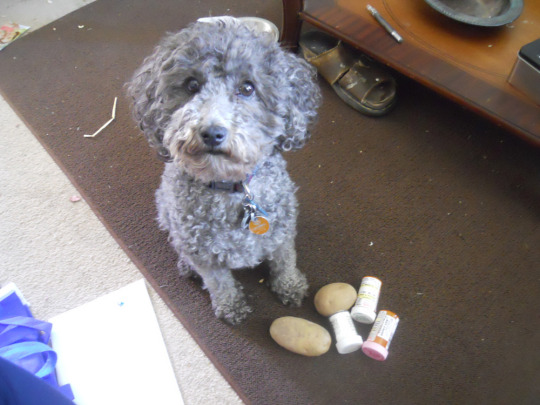
Today at therapy was really hard. I was sitting here crying, and generally being miserable, when I felt a nudge at my knee. I looked down to see that Zeus, my service dog, was doing his job… and brought me a potato.
it is very hard to cry with a gift of potato.
Remember this? I’m having a rough time right now. Zeus has a solution.
That would be an empty pill bottle, the *correct* pill bottle, a bottle of embossing powder, and two, TWO potatoes.
You’re worth at least 2 potato to him and that’s pretty special imo.
I would just like to remind you all that *I don’t own any potatoes* and I have no clue where he’s getting them from.
The 62 species of sea snakes are all wonderfully adapted to life in the oceans, but they almost always come ashore to lay eggs. But not the yellow-bellied one; it is the only member of the group that lives full-time in the open ocean. It eats at sea, mates at sea, and gives birth to live young at sea. It has special valves in its nose to stop water from getting in, and can even partially breathe through its skin. It hunts by sitting amid flotsam and picking off small fish that gather beneath it. And it swims by propelling itself with a flattened, paddle-like tail.
And yet, in some ways, it is so ill-suited to life in the ocean that its existence borders on poetic tragedy. For example, a few years ago, Brischoux and his colleague Harvey Lillywhite from the University of Florida showed that the yellow-bellied sea snake is almost constantly thirsty and dehydrated.
If you tried to swallow water in the ocean, your kidneys would remove the extra salt by diluting it in urine. In doing so, you’d actually get rid of more water than you ingested. This is why, when humans drink seawater, they get dehydrated. Some marine animals cope with this problem using special salt-removing glands, but Lillywhite showed that—contrary to what scientists previously believed—sea snakes do not. They live most of their lives in the oceans, but they never swallow seawater. Instead, they try quench their thirst with fresh water.
Some species stick close to coastal sites with nearby sources of fresh water, like springs or streams that empty into the sea. But the yellow-bellied sea snake has no such option. Instead, it drinks from the thin layers of freshwater that briefly form on the surface of the ocean when it rains. That seems precarious, and it is. For much of the year, from November to May, these snakes are almost constantly dehydrated.
The yellow-bellied sea snake isn’t a great swimmer either. “It is really small,” says Brischoux. “It can move in the water, but not for a very long period of time and not against really strong currents—unlike, say, a seal.” So how could it possibly occupy such a large range? The only other tetrapods that are so widespread are either powerful swimmers like the giant whales or strong fliers like seabirds. The yellow-bellied sea snake is neither, and yet it has spread over two-thirds of the Earth’s surface.
@betterbemeta are you able to translate this? Is it true horses can see netherbeings?? Will we ever know the extent of their powers???
I think I have reblogged this before but I’ll answer it again bc its a fascinating answer I feel and i was more funny than informational last time.
The truth is that horses see what they think are nether beings, I guess. They have a perfect storm of sensory perception that, useful for prey beings, marks false positives on mortal danger all the time. Which is advantageous to a flight-based prey species: running from danger when you’re super fast is much ‘cheaper’ than fighting, so you waste almost nothing from running from a threat that’s not there. Versus, you blow everything if you don’t see a threat that is there.
Horses also have their eyes positioned on the sides of their heads, which gives them an incredible range of peripheral vision almost around their entire body with only a few blind spots you can sneak up on them in. But this comes at the cost of binocular vision; they can only judge distance for things straight ahead of them. Super useful for preventing predators sneaking up from the sides or behind, but useless for recognizing familiar shapes with the precision we can.
Basically we now have a walking couch with anxiety its going to get attacked at any second, that can see almost everything, but mostly only out of the corner of its eye. It has a few blind spots and anything that suddenly appears out of them is terrifying to it. Combine that with that it actually has far superior low-light vision than us, and that its ears can swivel in any directions like radar dishes, and you’ve basically given a nervous wreck a highly accurate but imprecise danger-dar.
To be concise: all horses, even the most chill horses, on some level believe they are living in a survival horror.
This means that you could approach it in a flapping poncho and if it can’t recognize your shape as human, they mistake you for SATAN… or you could pass this one broken down tractor you’ve passed 100 times on a trail ride, but today is the day it will ATTACK… or your horse could feel a horsefly bite from its blind spot and MAMA, I’VE BEEN HIT!!!… or you could both approach a fallen log in the woods but in the low light your horse is going to see the tree rings as THE EYE OF MORDOR.
However, they actually have kind of a cool compensation for this– they are social animals, and instinctively look towards leadership. In the wild or out at pasture, this is their most willful, pushy, decisive leader horse who decides where to go and where it’s safe. But humans often take this role both as riders and on the ground. They are always watching and feeling for human reactions to things. This is why moving in a calm, decisive way and always giving clear commands is key to working with this kind of animal. Confusing commands, screaming, panic, visible distress, and chaos will signal to a horse that you, brave leader are freaked out… so it should freak out too!
On one hand, you’ll get horses that will decide that they are the leader and you are not, so getting them to listen to you can be tough– requiring patience and skill more than force. On the other hand, a good enough rider and a well-trained horse (or a horse with specialized training) can venture into dangerous situations, loud and scary environments, etc. calmly and confidently.
The joke in OP though is that many horses that are bred to be very fast, like thoroughbreds, are also bred and encouraged to be high-energy and highstrung. Making them more anxious and prone to seeing those ‘demons.’ All horses in a sense are going to be your anxious friend, but racehorses and polo ponies and other sport horses can sometimes be your anxious friend that thinks they live in Silent Hill.
Reblogging some horse knowledge for certain people who write fantasy books but know nothing about horses *cough cough*
YUUUUP. All this.
Horses are unpredictable uncanny demon-things, gotcha. And I love that there’s a Roman term for horse-gremlin.
To be concise: all horses, even the most chill horses, on some level believe they are living in a survival horror.
this is a great line.
I once talked to a guy who gives search-and-rescue training, and he says when there are mounted SAR trainees doing a search simulation, he has hidden himself in the woods and watched the human riders search past obliviously, while every single horse knew he was there.
This is quite amusing. It is true that horses have often been used to sniff out demons, witches, and monsters. I enjoy this, because while they may react to my presence, it is usually quite simple to subdue them, so long as I am well-fed. My aura has put the most skittish mount into a state of wide-eyed stillness.
The horse I ride is afraid of the sound of his own breathing smh.
My least favorite misconception about horses is that they can recognize fear and that they exploit this fear to take advantage of a nervous handler.
Now, I’ve handled horses with….willful attitudes who do like to take a mile for every inch a nervous or inexperienced ride allows.
HOWEVER. The truth is horses are almost never this devious. Horses are prey animals, and like is stated above, they’re programmed to be on edge. Humans are predators, and horses can tell. We raise horses to listen to, rely upon, and always be watching their human handlers for things as minuscule as hand gestures. Imagine now a horse, programmed to watch out for predators and relying on this seemingly all-powerful human predator for direction. And the human is scared.
The horse can sense it, but it has no idea that it could be the source of fear.
To a horse, its human handler being frightened is the equivalent of you running into a an angry grizzly bear, only for the bear to run away frightened after glancing behind you. You’d turn around looking for whatever monster scared it off.
What I’m saying is, when a horse senses your fear, it thinks “holy hell. If the human’s afraid, something really bad must be here. We’re doomed!!! ”
So yes. Horses sense your fear and act out. But it’s almost never because they’re taking advantage of you.
And if they are, be excited; you have a very smart horse.
There is a reason that I named my last horse Trickster, and that is because that motherfucking bitch was one of the smartest horses I’ve ever met.
Any horse who knows how to lull you into a false sense of “Everything is fine”, and then patiently waits for a split-second distraction to use an entire TREE to remove you from its back is a horse that knows what it’s doing, and what it’s doing is being a vengeful asshole.



 kiragecko