This is true! The zoo where I volunteer (the illustrious Columbus Zoo & Aquarium) was one of the pioneers of this program.
Our zoo is known for raising cheetah cubs. Cheetahs have a terrible infant mortality rate and cubs are often rejected, so we get a lot of cubs to raise from all over the country (other zoos and sanctuaries, mostly).
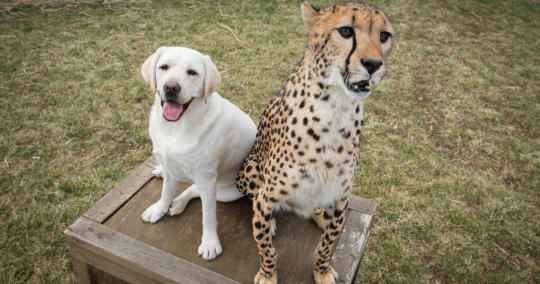
The cubs are placed with a puppy friend when they are wee and small, so they grow up together like littermates. They play together, wrestle, and the dogs (yellow Labs) are so calm, friendly and well-socialized that the cheetahs take behavioral cues from them. When they meet new people, or go into new situations (which they often do, as ambassador animals for cheetah conservation), they check out if their dog friend is feeling chill – which he is – and then they know it’s okay for them to be chill, too.
Basically the dog is a service animal for them.
The cats need their dog friends less and less as they get older and more comfortable, but they still often hang out as grownups.
Our zoo does cheetah runs, where the cheetahs get to chase a lure and show off their speed. Often they’ll have one of the cheetahs run (we have like twelve cheetah), and then they’ll have one of the dogs do the run to show how much faster the cats are. People get a kick out of that. The dogs…let’s just say they try their best.
Omg I’m crying, this is so beautiful. 😭
[First set of images are a comic, showing a cheetah and a dog sitting side by side. Dog’s tail is waving wildly. Text:
Cheetahs are very nervous animals and some zoos give them “support dogs” to keep them relaxed.
Dog leans back head: You’re so amazing!
Beat panel with dog still in ridiculous pose. Then cheetah turns to touch dog’s nose with their own. Dog closes eyes and flops their tongue out in joy.
Cheetah: Thanks.
Next image is a photo of a cheetah cub and a puppy cuddling, looking happy.
Final image is a grown cheetah and dog, sitting on a box in a similar position to the comic.
[Video description. No sound. A child and a baby goat are in a pink bedroom. The child is in bright pink pajamas.
Video starts with both kids pushing their heads together. The child pushes the goat back a little. Goat does a little goat jump. Child imitates. They do jumps again.
Child’s head is down so goat starts the headbutt challenge again. After a short push, goat pauses to jump. After, the child lets the goat push them back, and they flop onto their side, and then back, dramatically.
Jellyfish Lake in Palau. Apparently the jellies have lost their ability to sting because of lack of predators in the lake and you can swim with them!
BUCKET LIST.
WAIT BUT THAT’S NOT EVEN THE COOLEST PART: These jellyfish carry small populations of algae inside their bodies and derive much of their nutrition from the sugars that the algae produce. The jellyfish follow the sun across the lake each day and rotate continuously, so that the algae are always getting maximum sunlight exposure for photosynthesis. Then at night they dive to deeper parts of the lake so the algae can absorb nitrogen. It’s one of the best examples of endosymbiosis in action and it’s KICKASS.
FLOATY FRIEND CABBAGES
buoyant cabbages o’luv
I want to go there ❤ Moon jellies ‘n golden jellies
Just when we thought octopuses couldn’t be any weirder, it turns out that they and their cephalopod brethren evolve differently from nearly every other organism on the planet.
In a surprising twist, scientists have discovered that octopuses,
along with some squid and cuttlefish species, routinely edit their RNA
(ribonucleic acid) sequences to adapt to their environment.
This is weird because that’s really not how adaptations usually
happen in multicellular animals. When an organism changes in some
fundamental way, it typically starts with a genetic mutation – a change
to the DNA.
Really interesting short read for those interested in evolution.
stupid non-cephalopodes: evolve through a relatively stable updating of genetic matrices
grand cephalopod savants: biohacking into the nature mainframe and leaving eldritch comments in the engine’s source. what the fuck is a “stable release”
It’s a baby bat ray brunch! Using plate-like teeth to grind and chew their sustainable seafood, these youngsters will grow quickly into their role as majestic sea flap flaps.
It’s not Shark Week without some flat shark love as well! These shark cousins and fellow elasmobranchs can grow to 200 pounds, with a wingspan of six feet.
I once read about an aquarium that trained the dolphins to pick up any debris in the tank and give it to the trainer in exchange for fish. One dolphin started started hiding paper under a rock and then breaking off small pieces to give the trainer. She also realized that she could get fish for catching a seagull. She soon started to stockpile fish to use as seagull bait, thus creating an exponentially larger seagull problem. Then she taught the other dolphins, which made it worse. So if you ever think dolphins are cute, remember that these little assholes create capitalism of their own volition and are not to be trusted.
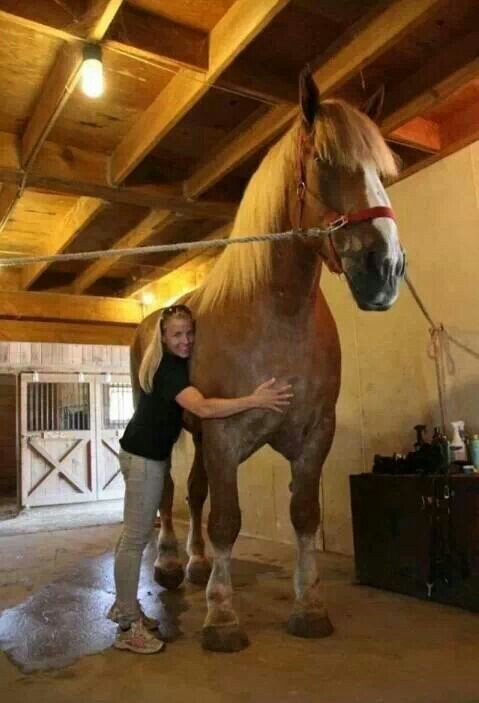
I never made a post about draft horses. :T They are the gentle giants of the horse world, sometimes growing as large as 20 hands and over 2000 lbs. The tallest horse in the world is an American-type Belgian horse named Big Jake (I think???).
A very big (but good) boy!
Despite their size, draft horses are known for their quiet, even temperaments, which make them good work horses. They were originally bred to pull wagons and plows, and they still do that. The most famous draft horses are probably the Budweiser Clydesdales, i.e. the horses in those Superbowl commercials that make us cry every goddamn year.
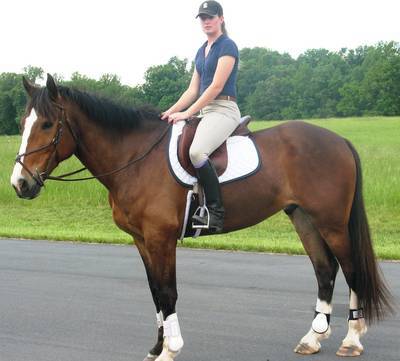
Draft horses can be ridden, and they are often crossed with lighter breeds, such as Thoroughbreds and Quarter Horses, to create tall, sturdy-boned, quiet sport horses.
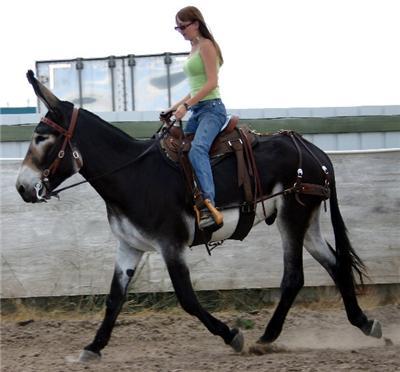
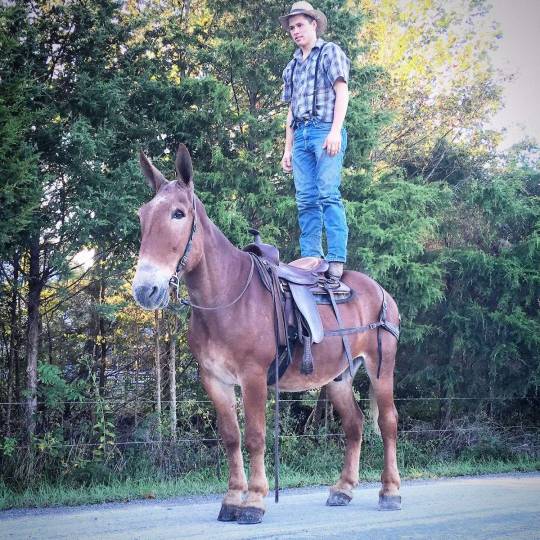
Such horses were a common sight during foxhunts, as “hotter” breeds, like Arabians and Thoroughbreds, tend to lose their minds a bit in the chaos of the hunt. Draft horses can also be crossed with Mammoth Jack donkeys to create draft mules, which are also used to pull plows for the Amish.
Mammoth Jack donkey:
Draft Mule:
There are a lot of draft breeds, some more common than others. Many of the common ones are easy to tell apart from the others, but they’re all large-boned and tall, except for the draft ponies, such as Halflingers and Norwegian Fjord horses.
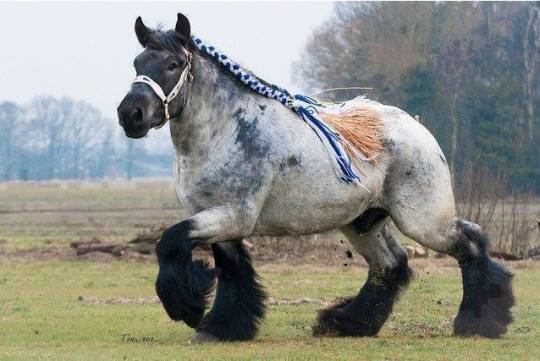
The Belgian
There are two Belgian horses, one that’s popular in Europe and another that’s very common in the US.
This is the European-type “Brabant” Belgian, which tends to be very thick boned and roan in color.
This is the American-type Belgian, which is lighter-boned and always sorrel/palomino in color:
Here is a Brabant Belgian mare pulling some shit:
A lot of draft horses really do enjoy pulling stuff, as much as a horse CAN enjoy doing anything that’s not eating grass and farting. Horse pulls are a common sight in Middle America, often done using Belgian horses. Here’s one of a team pulling 9200 lbs. They pull for a very short period of time, often only a few seconds.
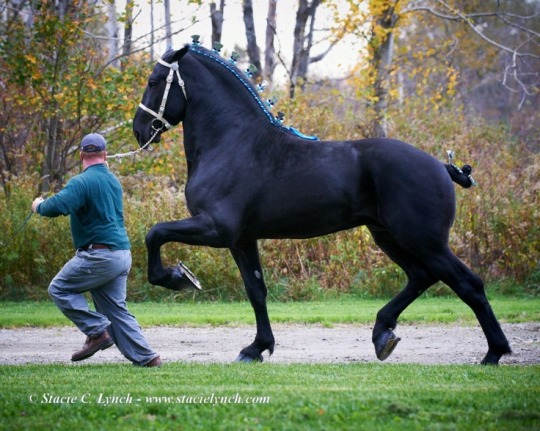
Next up is the Percheron, which has a similar body type to the Belgians but are always black or dapple. They can be slightly more spirited than Belgian horses, with some demonstrating high stepping action.
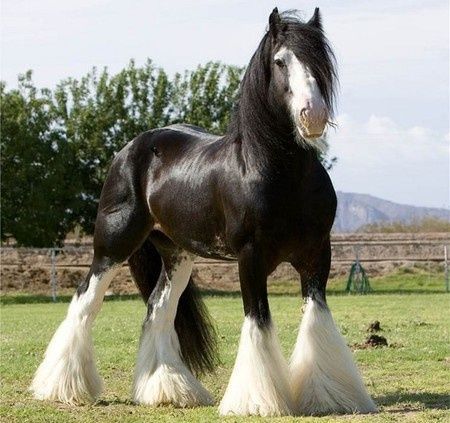
They are not to be confused with Friesians, who have much more “feathered” legs and feet (long hair around the lower legs) and are lighter-boned. Friesians also don’t come in dapple colors, like the horse at the top of this post.
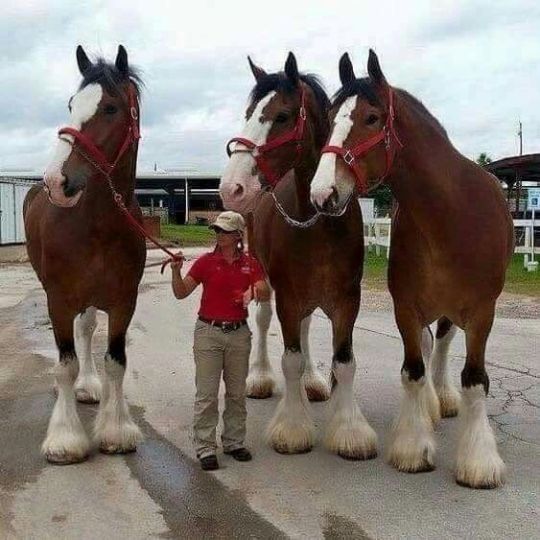
Clydesdales
Clydesdales are recognizable because they are a) always bay colored and b) almost always have four white socks and a blaze on their faces. They also have much more feathering on their legs than Percherons or Belgians. Clydesdales are more common in parades and the like because they tend to be slightly lighter than Percheron and Belgians, and because of this, they’re more agile and “showy”. You probably would not want to plow with a Clydesdale. You could, but their feathering means their feet get dirty much easier than a Belgians might.
Shire Horse
Shires come in a variety of colors, usually black or bay, and they are probably the most “feathered” horses of the popular breeds. They’ve got lots of fur on their feet.
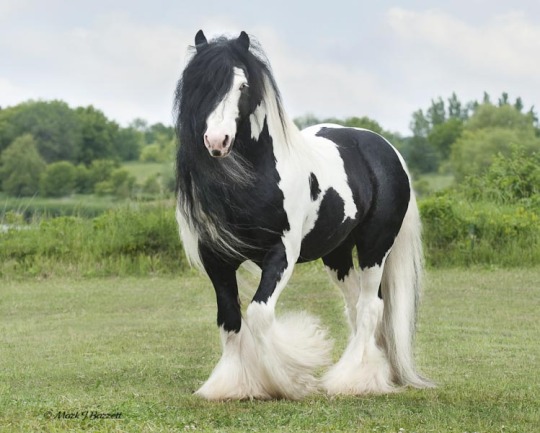
Gypsy Vanner Horses
Gypsy Vanner horses got their start pulling Roma wagons, but now they’re mostly used in fantasy photoshoots, and you can see why. They are beautiful horses, definitely not the type you’d want toiling in the muck. They are almost always paint colored, which distinguishes them from Shire horses.
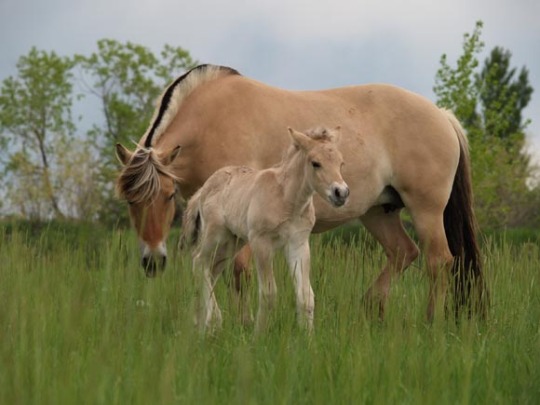
These are the main, most popular and commonly seen full-sized draft breeds, at least in the US. However, there are also draft ponies, the most popular of which is the Halflinger, which resembles a shrunken Belgian horse. They are ALWAYS sorrel/palomino colored, but their frame can vary. Some Halflingers are lighter-boned and more suitable for riding. Others are thicker-boned and better for pulling.
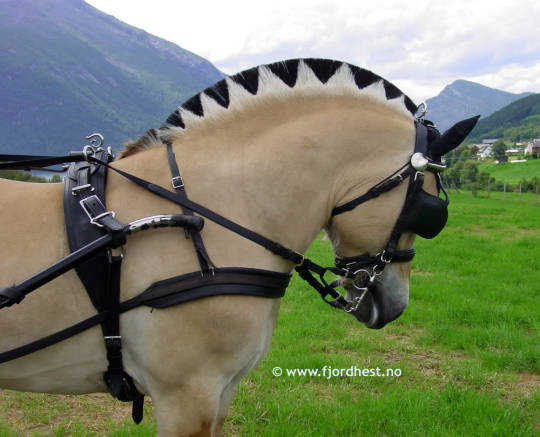
The other unmistakable draft pony is the Norwegian Fjord, easily recognized by the black stripe in the center of its mane, like a reverse ice cream sandwich.
This can lead to some creative hair cuts
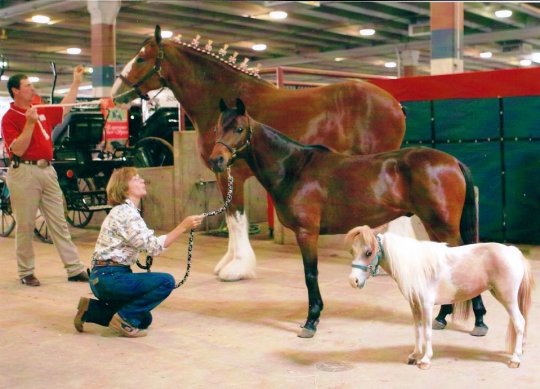
So there you go. That’s a somewhat comprehensive review of draft horse breeds. Here is a size comparison for funsies, with the average riding horse in the middle.
I dislike you all. My husband WOOED ME with this song and it still haunts me to this day. How dare it be so catchy. How dare people constantly say “cat” in just this voice and send me into flashbacks.








 kiragecko